Kraj: Sesto San Giovanni (Milano), Italija
Datum intervjuja: 21.10.2008
French TV is a legendary American band that started out in the early 80s when the American version of the Rock in Opposition movement began. During the years, they have released a number of brilliant albums, but have unfortunately remained fairly obscure even among fans of more experimental music. RockLine talked to the only original player left, bass player Mike Sary, at the Altrock festival in Italy.
Rockline: Have you been enjoying the festival?
French TV: Oh yeah. I am familiar with most of the bands, so this was actually something I was really looking forward to. I have CDs of most of the bands, but I’ve never seen them play live before.
Rockline: How are you happy with the show you played?
French TV: I had my problems with it. I left my tuner and some equipment in one of the other places that we played. There was a moment last night when I started getting more and more out of tune and I had to compensate my playing, but it just kept getting worse.
Rockline: But you couldn’t really sense it.
French TV: That’s good to hear. Normally when I’m on stage, I move around a lot more, I jump around, but I was out of tune and had to adjust my playing, so I had to be very careful.
Rockline: What about the entire tour? Have you been enjoying that?
French TV: Yeah. It started off not so well, but it’s been going great and the band has been getting better and better. I’m pretty happy with the way things have turned out. The audiences have been wonderful, they buy our CDs and they buy us beer. They’ve been very nice to us.
Rockline: Have the keyboard player and drummer been on the tour the whole time?
French TV: Yes.
Rockline: What about the original French TV members?
French TV: We’ve had a lot of line-up changes over the years. I would say that by as early as the second album I had become the leader. Even though it’s called French TV, this is basically my group, so I have to find people I can trick into playing this sort of music. We do have a regular drummer back in the States but he had a work situation and couldn’t leave for this tour. That’s when I discovered Michael and asked him if he could play.
Rockline: So, were you familiar with Sotos?
French TV: Oh yes. I have the second Sotos record (Platypus) and the Zaar as well.
Rockline: Are you happy with the job the two new guys did?
French TV: I’m very happy. This is Paolo’s second tour with us, so I knew what to expect from him. Michael has a myspace page, with videos of him playing King Crimson, Magma, Sotos and Zaar. Watching those, I knew that he would be able to learn things very quickly. Instinctually, I knew he’d be fine, but you never know until you’re together in the same room.
Rockline: Are these guys playing note for note or are they improvising something?
French TV: That’s kind of hard to say. I think they’re faithful to the arrangements. They might phrase it a bit differently here and there. In terms of keyboards, we do a lot of layering on the records. You might have three different keyboard lines going on at the same time, so Paolo has to choose which one is the strongest, which seems to get the idea of the song across. It’s a mix, but there’s very little improvisation. Once everybody finds a part they’re comfortable with, they stay with it.
Rockline: So, when you go to the studio, you use all the capabilities of the studio even though you know you won’t be able to duplicate it live?
French TV: Yes, yes. We don’t exactly plan it that way. When you’re in a studio, it’s like being in a candy store. You want this and that. When you go on tour, you get the tummy ache.
Rockline: So basically it all depends on how many ideas you have when you go to the studio and how much you want to incorporate them into the music?
French TV: Right. Even if we were able to faithfully duplicate the record on stage, something would still be missing. It’s almost like the difference between a book and a movie about the book.
Rockline: Yesterday you told me about the financial difficulties of touring in Europe. What makes you want to do this despite the problems?
French TV: I like the camaraderie of the musicians. In some ways, recording a CD is similar to being a research scientist. Performing in front of a live audience shows you if the music works in practice or not. So, it’s very fulfilling. Being able to get rid of the boxes of CDs I have at the house helps as well.
Rockline: You release the CDs on your own label. When did you decide to do this and why?
French TV: There really weren’t that many label interested in this music. My partner Steve Roberts was much more educated about the distribution of progressive bands. He helped to make it clear to me that it is possible to do these things yourself. If a label had offered to put out our CDs, I would have done it. At the same time, I know many bands who would wait for years, literally, before getting a firm answer from a label and if they did get the answer, the labels would interfere with the content of the music. It would be nice to be on a label, but the headaches involved seem to be more trouble than what it’s worth. The Russian label Mals asked us about rereleasing our records, so they could sell it in Eastern Europe and we said yes.
Rockline: What about the Cuneiform label? Were you not aware of them?
French TV: Yes. For our first three records, we always asked them if they’d be interested in putting us out. I think he was being kind. He would always tell us that his schedule was booked for years in advance. I suspect we weren’t interesting enough for him.
Rockline: I hear you use the term progressive. Some people in avant-garde music don’t like this term. How come you use it?
French TV: I think it’s kind of silly to be upset at the way your music is labelled. I have to sympathise with the listener because it’s an honest question: What kind of music does this band play? I think the term progressive rock is broad enough to encompass many shades. In some ways, it’s very meaningless. If you’re considered progressive rock, does that mean you sound like Univers Zero or Arena? I suppose it’s a way to narrow it down slightly. Ultimately, the term progressive rock is meaningless, so it’s hard to get upset about it.
Rockline: When you started out, did you find yourself sympathising with the rock in opposition movement?
French TV: Oh yes! I think that when we started I was somewhat aware of Samla Mammas Manna, Univers Zero, Etron Fou, Henry Cow and the others. My partner at the time, Steve Roberts, who was a record distributor himself, was much more knowledgeable about these bands. He helped introduce me to many independent progressive bands, including the RIO bands. Some of the bands… the second I heard them, I thought they were the greatest thing in the world. It took me a while for them to grow on me. I would say that’s where the majority of my interest in progressive music lies.
Rockline: I already asked you this yesterday. Can you tell me what kind of bass you play?
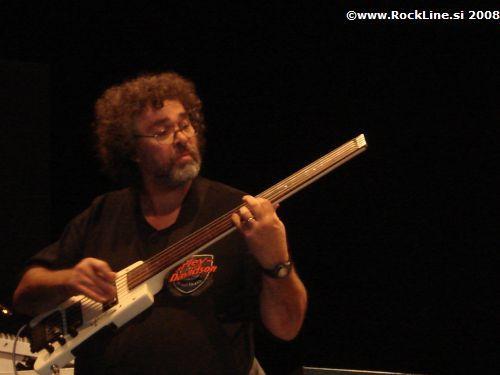
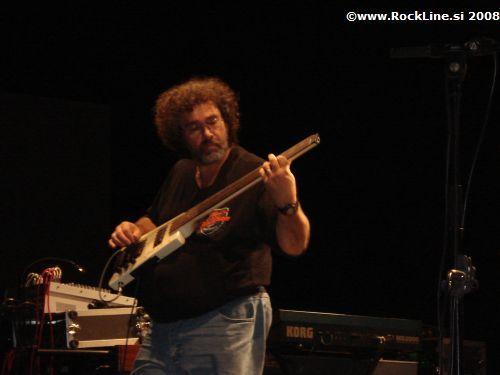
French TV: It’s a Steinberger 5-string. Originally, it had frets but after studying Percy Jones’ bass I thought I need to get serious about playing a fretless. So, I had the frets taken out of my bass. This is actually the first tour in which I’ve played fretless. For years and years I practiced fretless and played it in studio, but I was somewhat uncomfortable playing it in public. So far, I’m happy with the way it’s turned out.
Rockline: Why did you decide on this particular bass?
French TV: It’s a very compact and light bass. When you’re touring, you have to economize the space as much as possible. I’ve had the bass since 1994.
Rockline: Have you always taken it on tour, even when it had frets?
French TV: No. I have about 5 or 6 basses and oddly enough I played a different bass on every tour. Last time I came to Europe, I had a Cort 6-string bass. It’s only been the last two years that I’ve been playing fretless, but I think I’ll be using this bass for a while.
Rockline: Can you tell me something about the upcoming album? What will it sound like?
French TV: After our previous album, our keyboard and sax player left. Not long after that, a new keyboard player moved where I live. His name is Steve Katsikas. He has another progressive band called Little Atlas. In many ways, he’s a more traditional player as opposed to Warren. If Steve had his way, he’d just play piano, organ and mellotron. He has more of a tendency to want to fill up space with chords as opposed to Warren’s more conflicting melodic lines. Steve is a more basic player, but I think he’s always wanted to do more experimental stuff. He’s had a lot of fun working on the new songs. The last 4 albums, I would send the rhythm tracks to Warren Dale, but working with Steve, I am actually sitting with him and we create parts together. So I’m there to tell him when to put away the mellotron.
Rockline: Is he now a regular member?
French TV: No. Only for the studio. He doesn’t have confidence in his abilities to recreate the tunes and the sounds, which is kind of a shame. He could do it if he had the time, but this isn’t the case. In terms of the compositions, I’m very happy with what we created together with the other drummer Jeff Gard. I hesitate to say it’s complex because that would imply that complicated is better. But we’ve been able to develop themes a lot more. It’s hard to say what makes the new material unique. I suspect that you’ll be able to hear immediately that it’s French TV.
Rockline: So it does have that familiar French TV feel to it?
French TV: Yes. There are all sorts of unexpected sections.
Rockline: Funny song titles?
French TV: Yeah.
Rockline: That’s another thing I wanted to ask you. The reaction of the audience to your humour was very cold. How did you feel about that?
French TV: I occasionally run into this problem when I play in Europe. I have to remind myself that 80% of it is the language barrier, but some percentage of you also thinks that what you’re saying isn’t funny and you’re wasting your time, so I kept the introductions very brief when I realized that what I was saying wasn’t getting across, that it wasn’t entertaining enough.
Rockline: But the reaction is probably different in America?
French TV: Yes, but even in Europe. I can’t seem to predict how the crowd will react. Some nights, everything is funny and working. In addition to jokes, I like to tell stories. Sometimes, European crowds love it. They laugh at all the right places. At other times, it seems more like you’re in a recital hall. I wish it was more predictable.
Rockline: Thanks for the interview
French TV: No problem.
Galerija slik